Mem — AI Assistant for Smarter Teamwork
Role: Product Designer / UI/UX & Visual Designer
Focus: AI Product Design · UX/UI · Workflow Design · Visual Identity
Year: 2026
Overview
Mem is an AI-powered workspace designed for a small advertising production company to simplify everyday teamwork and reduce the amount of information employees have to keep in their heads.
The product brings tasks, deadlines, project details and important operational information into one place, helping the team stay focused and work more efficiently.
I designed the product from the initial concept through its UX/UI and visual direction, exploring how an AI assistant could become a practical part of the company’s everyday workflow rather than just another standalone tool.
The problem
Advertising production involves a large number of parallel processes.
Projects move between managers, production teams, suppliers and contractors. Deadlines change, new requirements appear, technical details need to be remembered, and information is often distributed across different messages, documents and tools.
The main problem was not the lack of information — it was too much fragmented information.
Employees had to constantly switch between different sources, remember project details and manually keep track of what needed attention.
The challenge was to create a simple system that could bring this information together and make it easier to access through one interface.
Product challenge
The key question was:
How can an AI assistant understand the context of everyday work and help the team without making the workflow more complicated?
Instead of creating another complex project-management system, I focused on making the interaction feel closer to working with a personal assistant.
The product needed to help users quickly understand:
What needs to be done? What is important right now? What deadlines are approaching? Where can I find the information I need?
The interface therefore had to remain simple even when the underlying information was complex.
The solution
Mem was designed as a central AI-powered workspace where users can work with tasks, deadlines and project information through a single assistant.
The assistant helps organize incoming information, keep important details visible and provide a clearer overview of ongoing work.
Instead of requiring users to remember where specific information is stored, the system is designed around context: users can interact with the assistant and access relevant information from different parts of the workflow in one place.
This reduces unnecessary switching between tools and makes everyday operational work easier to manage.
Designing the AI experience
A major part of the project was thinking about how people should interact with an AI system in a professional environment.
The experience needed to feel helpful without becoming overwhelming.
I focused on creating a clear hierarchy between conversation, tasks, contextual information and actions, so users could understand what the assistant knows, what requires attention and what they can do next.
The goal was to make AI feel less like a separate technology and more like a natural layer within the team’s existing workflow.
UX/UI
The interface was intentionally kept minimal and focused.
Instead of exposing users to complex dashboards and large amounts of data at once, the experience prioritizes the information that is relevant to the current task.
I worked on the structure of the workspace, interaction logic, visual hierarchy and different interface states, balancing the conversational nature of AI with the more structured requirements of project and task management.
The design needed to support quick everyday interactions while remaining scalable enough for more complex workflows.
Visual identity
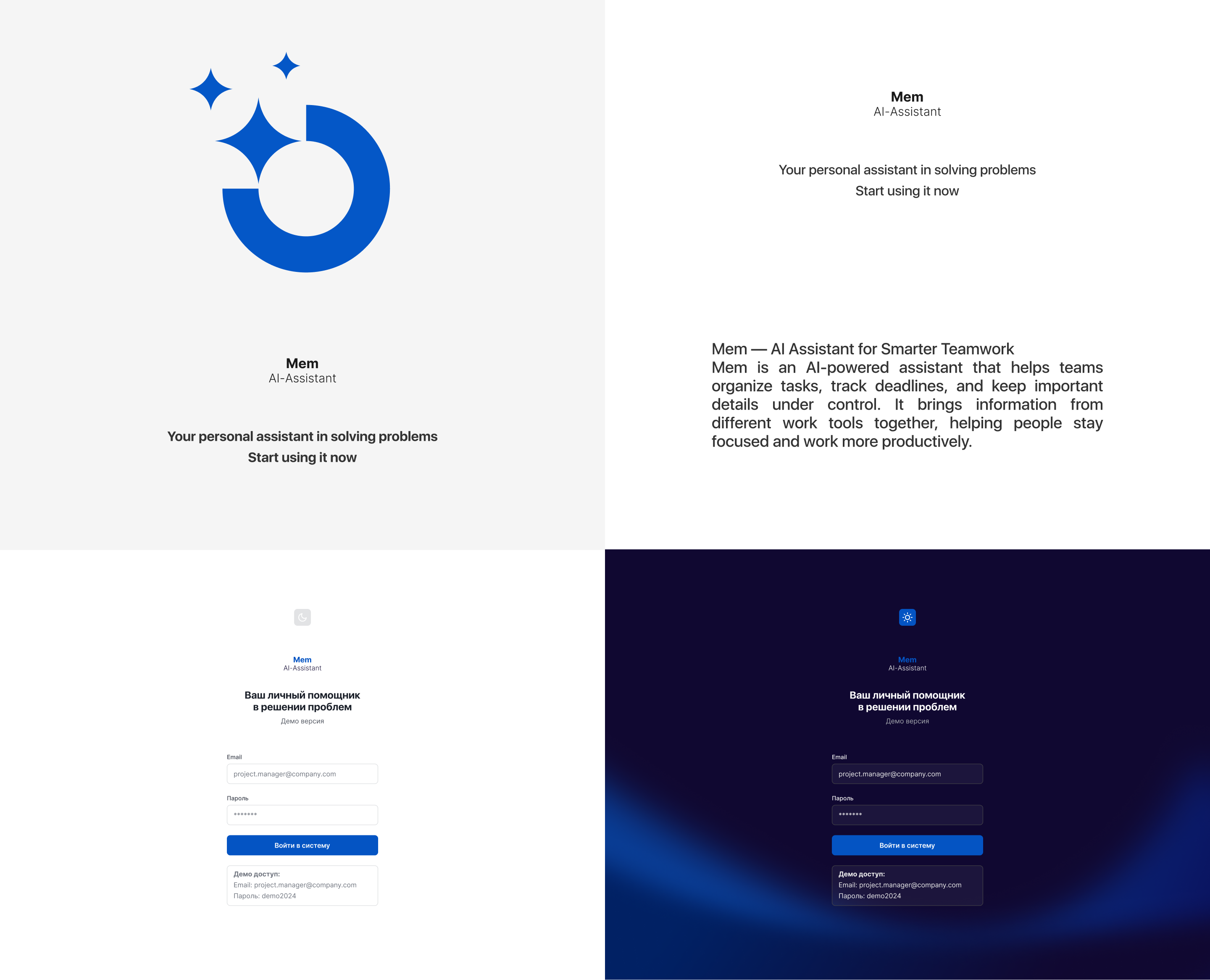
Alongside the product experience, I created the visual direction for Mem.
The identity is based on a simple geometric symbol combined with a restrained interface system. The visual language was designed to feel technological and contemporary without relying on the typical visual clichés associated with AI products.
Typography, colour, iconography and interface elements were developed as one system so that the product identity and UX feel consistent across different screens and touchpoints.
Product thinking
Mem was also an opportunity to explore a broader product question: how AI can be integrated into the internal processes of a small company.
Rather than starting with AI capabilities and searching for ways to use them, the product was built around actual workflow problems — fragmented information, repetitive coordination and the cognitive load of managing multiple projects simultaneously.
AI became a tool for simplifying those processes rather than the purpose of the product itself.
Outcome
The result is an AI-assisted workspace that brings everyday operational information into one clear environment and helps the team manage tasks, deadlines and project context more efficiently.
For me, Mem combines AI product design, UX/UI, workflow design, visual systems and product thinking within one project — exploring how emerging technology can solve practical business problems while remaining simple and understandable for the people using it every day.